CAPTIVATING SIMS

NOT FOR BROADCAST
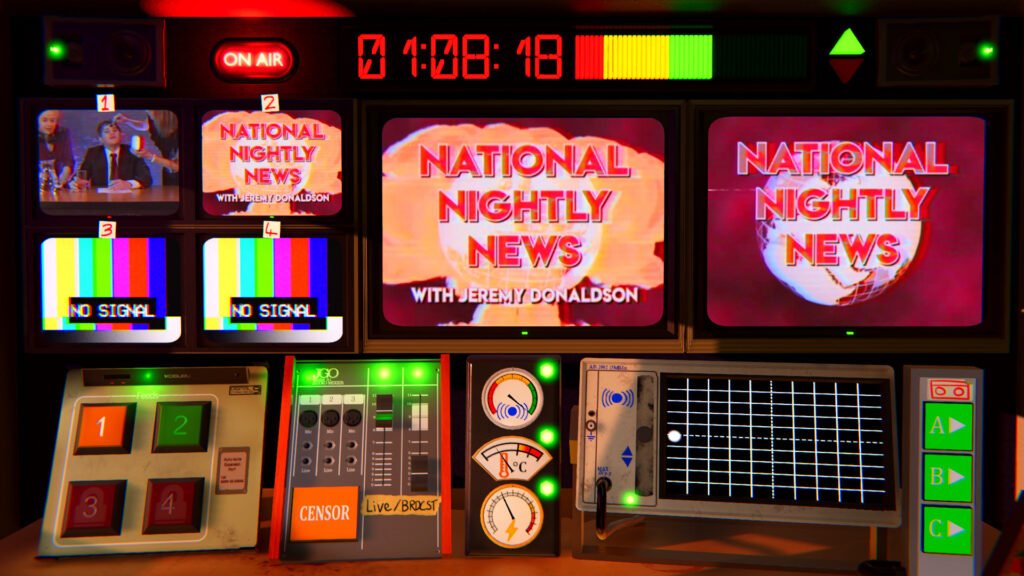
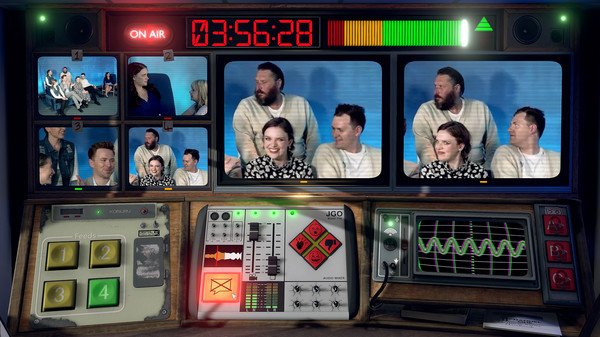
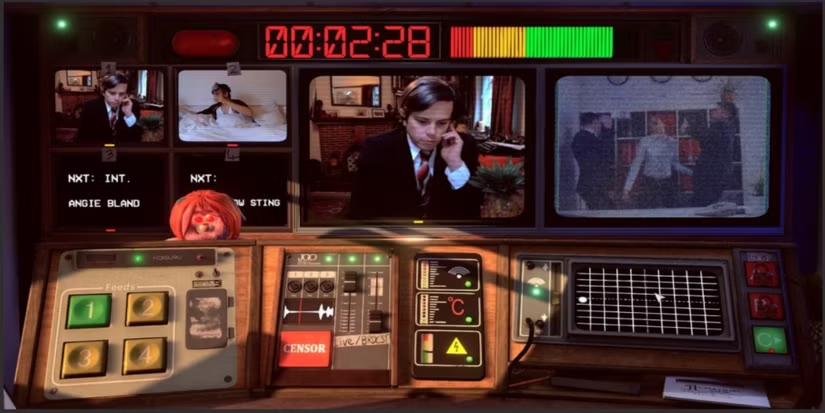
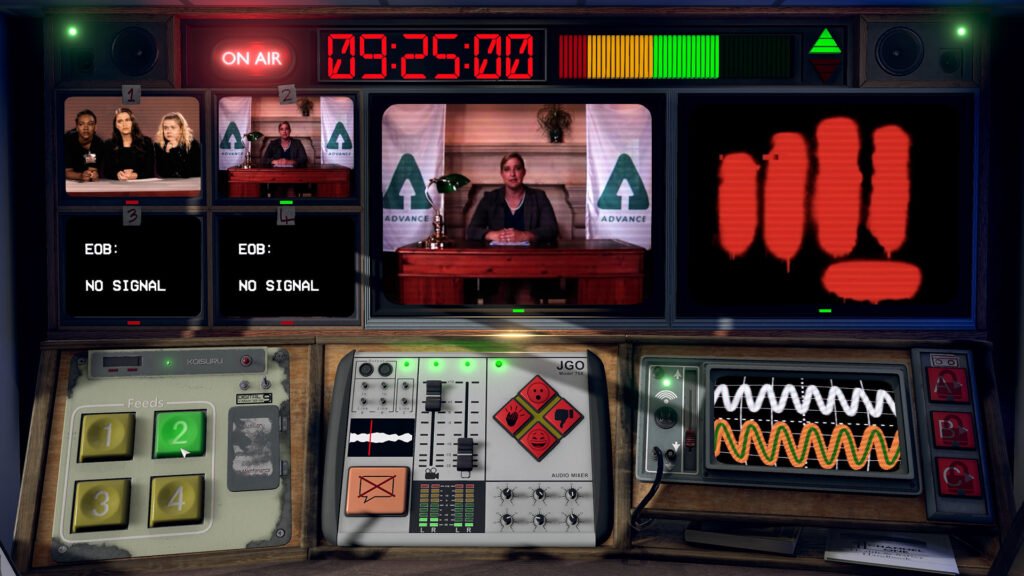
Not For Broadcast is one of the most inventive simulation games of the last decade—an unsettling, darkly funny, and often stressful experience that turns the simple act of pressing buttons into a moral crucible.
At its core, Not For Broadcast puts you behind the scenes of a live television news studio in a near-future Britain sliding into authoritarianism. You’re not the anchor, not the politician, not the hero. You’re the technician. Your job is to switch cameras, censor profanity, balance audio levels, and keep the broadcast from collapsing into chaos—all while the world outside your control room quietly (and sometimes loudly) falls apart.
What makes the game remarkable is how mundane its mechanics feel at first. Switching feeds, adjusting volume dials, hitting the censor button—it all seems mechanical, even boring. But as the broadcasts escalate, those same actions become agonizing choices. Which camera angle do you show when violence erupts? Which voices do you silence when the government tightens its grip? Do you keep the feed clean and compliant, or let dangerous truths slip through live television?
The FMV presentation is a bold and largely successful gamble. The performances are sharp, often hilarious, and occasionally chilling. Satire dominates the early hours, with absurd commercials and ridiculous pundits, but the tone gradually darkens. Jokes curdle into propaganda. Harmless technical errors turn into career-ending—or life-altering—mistakes. The shift is subtle, and that’s what makes it effective.
Mechanically, Not For Broadcast thrives on pressure. Later broadcasts overwhelm you with multiple simultaneous failures: audio distortion, missing footage, swearing alarms, emergency alerts, and moral decisions that demand attention right now. It’s intentionally stressful, sometimes to the point of frustration, but that stress is the point. You feel what it’s like to be a tiny cog in a massive media machine that never stops rolling.
The narrative is impressively reactive. Your technical decisions ripple outward, affecting public opinion, character fates, and the political trajectory of the country. You’re never given a clean “good” option—only trade-offs. Even acts of quiet resistance come at a cost, reinforcing the game’s central theme: power doesn’t only belong to those on camera.
If there’s a weakness, it’s pacing. Some segments drag, and replaying certain broadcasts to see alternate outcomes can feel repetitive once the novelty fades. The controls, while intentionally fiddly, may also alienate players who prefer clarity over chaos.
Still, Not For Broadcast is a rare kind of game: one that uses simulation not for mastery, but for discomfort. It’s not about winning. It’s about surviving the broadcast—and living with what you chose to show the world.
Verdict:
Not For Broadcast is a tense, clever, and morally sharp simulation that turns media control into a form of storytelling. It’s uncomfortable by design, frequently funny, and disturbingly relevant—a standout experience for players willing to sweat under studio lights and ask themselves who really controls the narrative.
PRISON SIMULATOR
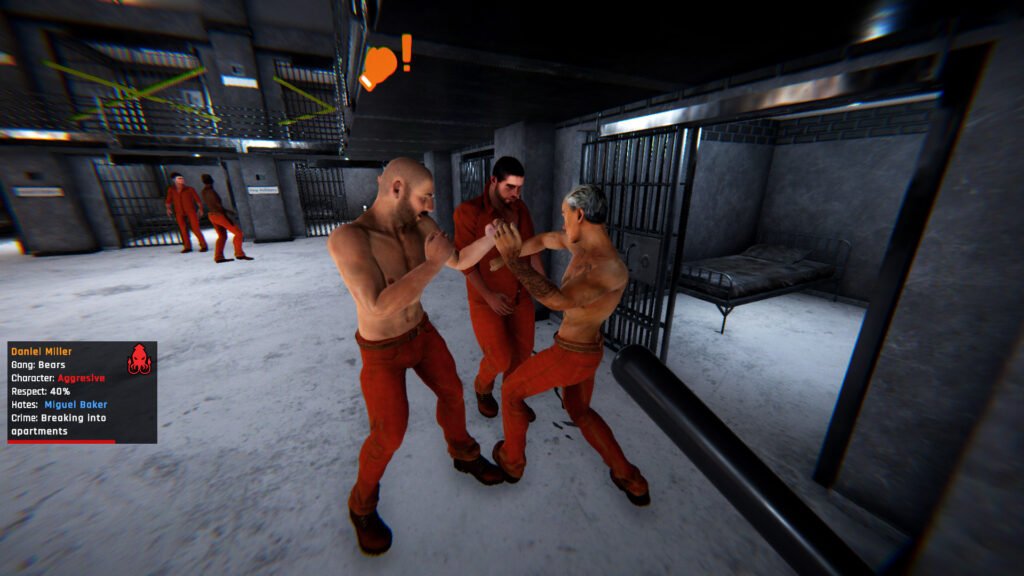
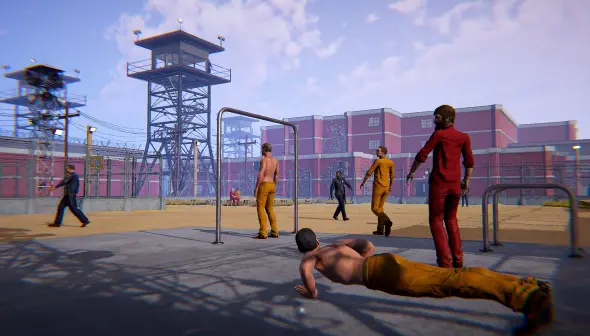
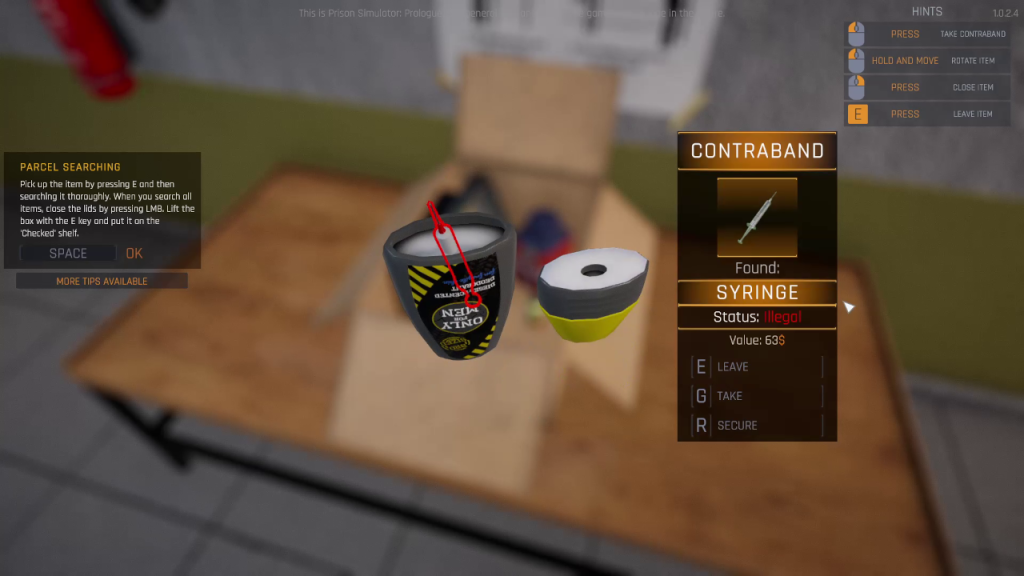
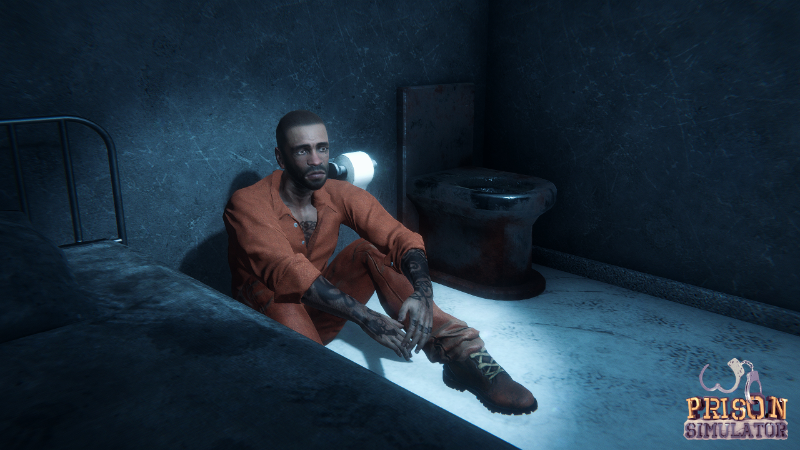
Prison Simulator is a deliberately grim, often darkly humorous management sim that drops you into the boots of a correctional officer and asks a simple question: how well can you maintain order in a place designed to break it?
From the outset, the game makes it clear that this is not a power fantasy. You’re not a hero, and you’re certainly not a savior. You’re a cog in an unforgiving system, juggling paperwork, inspections, inmate needs, and the constant threat of violence or unrest. The core gameplay revolves around day-to-day prison operations—conducting cell searches, checking inmates for contraband, managing meals, handling complaints, escorting prisoners, and responding to emergencies as they unfold.
Where Prison Simulator shines is in its atmosphere. The prison feels claustrophobic and tense, even during routine tasks. The echo of footsteps in corridors, the constant chatter and shouting from inmates, and the ever-present sense that something could go wrong at any moment give the game a persistent low-grade anxiety that feels intentional. The visuals aren’t cutting-edge, but they’re effective: bleak concrete interiors, harsh lighting, and utilitarian design reinforce the oppressive mood.
The progression system provides a steady sense of forward momentum. As you gain experience, you unlock new abilities, tools, and access to additional prison areas. This creates a satisfying loop—each shift becomes slightly more manageable as you learn how to prioritize tasks and anticipate problems. There’s also a light narrative layer, with recurring inmates and moral choices that hint at larger systemic issues without ever becoming preachy.
That said, Prison Simulator isn’t without flaws. Repetition can set in, particularly during longer play sessions. Many tasks follow the same patterns, and while new mechanics are introduced gradually, the core gameplay loop doesn’t radically evolve. The AI can also be inconsistent—sometimes prisoners behave believably, while other times their actions feel arbitrary or immersion-breaking.
Despite these issues, the game succeeds because of its tone and intent. It doesn’t glamorize incarceration or oversimplify prison life. Instead, it presents an uncomfortable, often morally ambiguous experience where efficiency, authority, and empathy are in constant tension. The occasional dark humor—often born from absurd situations rather than jokes—helps keep things from becoming overwhelmingly bleak.
Verdict: Prison Simulator is a solid, atmospheric simulation that excels at making the mundane feel tense and meaningful. While repetitive elements and uneven AI hold it back from greatness, players who enjoy grounded sims with a strong sense of place and moral complexity will find it engaging. It’s not always fun—but that discomfort is very much the point.
Don’t Miss Out
Sign Up Today for Exclusive Offers and Updates!
Mad Gamer Deals is dedicated to providing gamers with the latest and greatest in games and equipment for premium experiences.